Austin Kleon

Austin Kleon

Typewriter interview with Vijay Gupta

10 questions for the violinist and author about music, practicing with joy, and being "on the hook”

Austin Kleon's avatar
Austin Kleon
Jul 07, 2026
∙ Paid
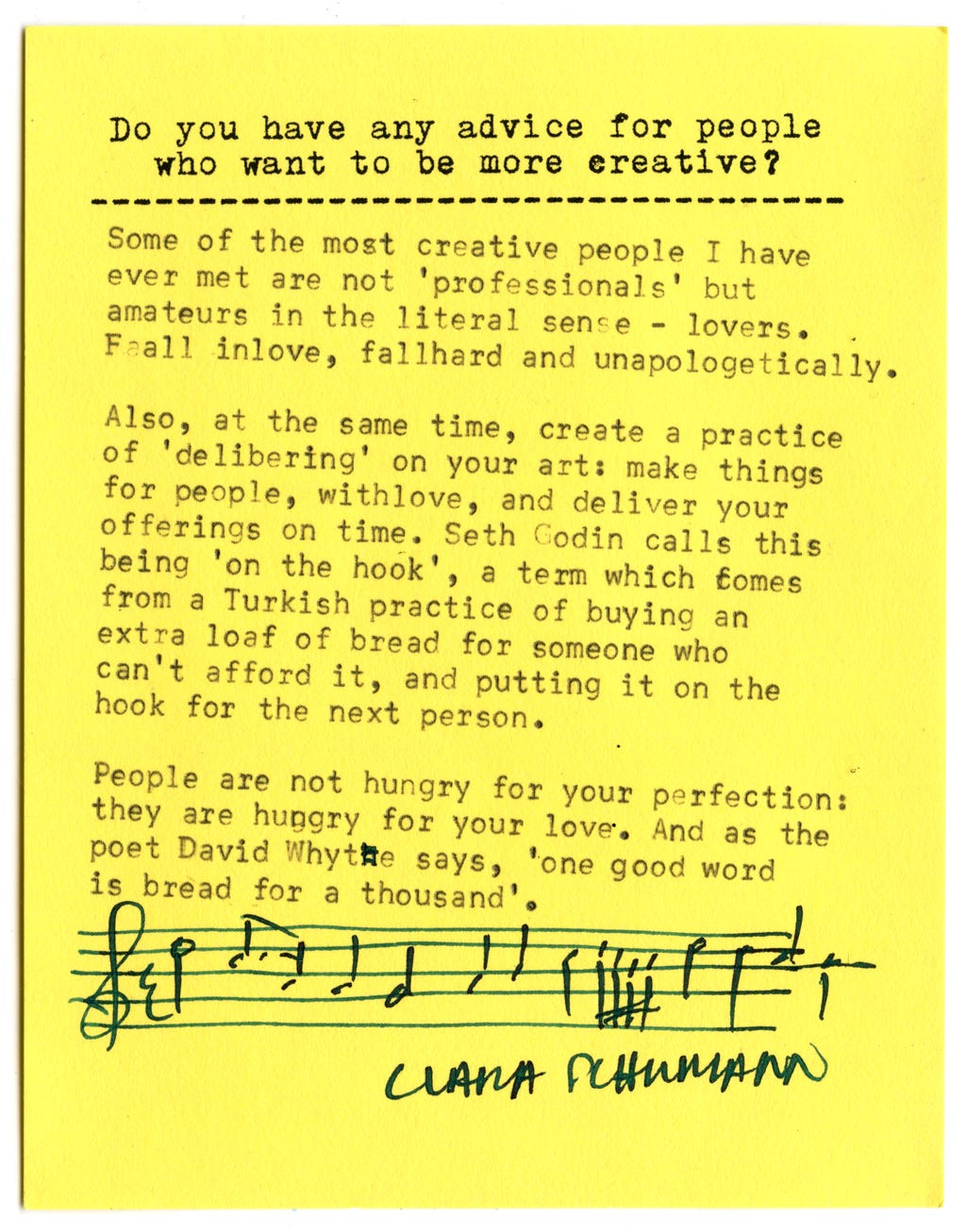
Do you have any advice for people who want to be more creative?  Some of the most creative people I have ever met are not 'professionals' but amateurs in the literal sense - lovers.  Fall in love, fall hard and unapologetically.  Also, at the same time, create a practice of 'delivering' on your art: make things for people, with love, and deliver your offerings on time. Seth Godin calls this being 'on the hook' , a term which comes from a Turkish practice of buying an extra loaf of bread for someone who can't afford it, and putting it on the hook for the next person.  People are not hungry for your perfection: they are hungry for your love. And as the poet David Whyte says, 'one good word is bread for a thousand'.

Hey y’all,

Vijay Gupta is a Grammy-nominated violinist, speaker, and founder of Street Symphony. Last month he published his first book, Restrung: A Memoir of Music and Transformation, which I had the pleasure of blurbing:

“Ten years ago, I was watching a 1996 episode of Reading Rainbow with my son when I found myself captivated by the intensity of a bespectacled 8-year-old violin prodigy. I desperately wanted to know what became of this kid—did he conquer the world or have a complete breakdown? The kid was Vijay Gupta, and Restrung is his story: a memoir about classical music, family, and surviving what we call ‘The American Dream.’”

This typewriter interview was conducted via the magic of the United States Postal Service. (For a plain-text version with links, see the P.S. below.)
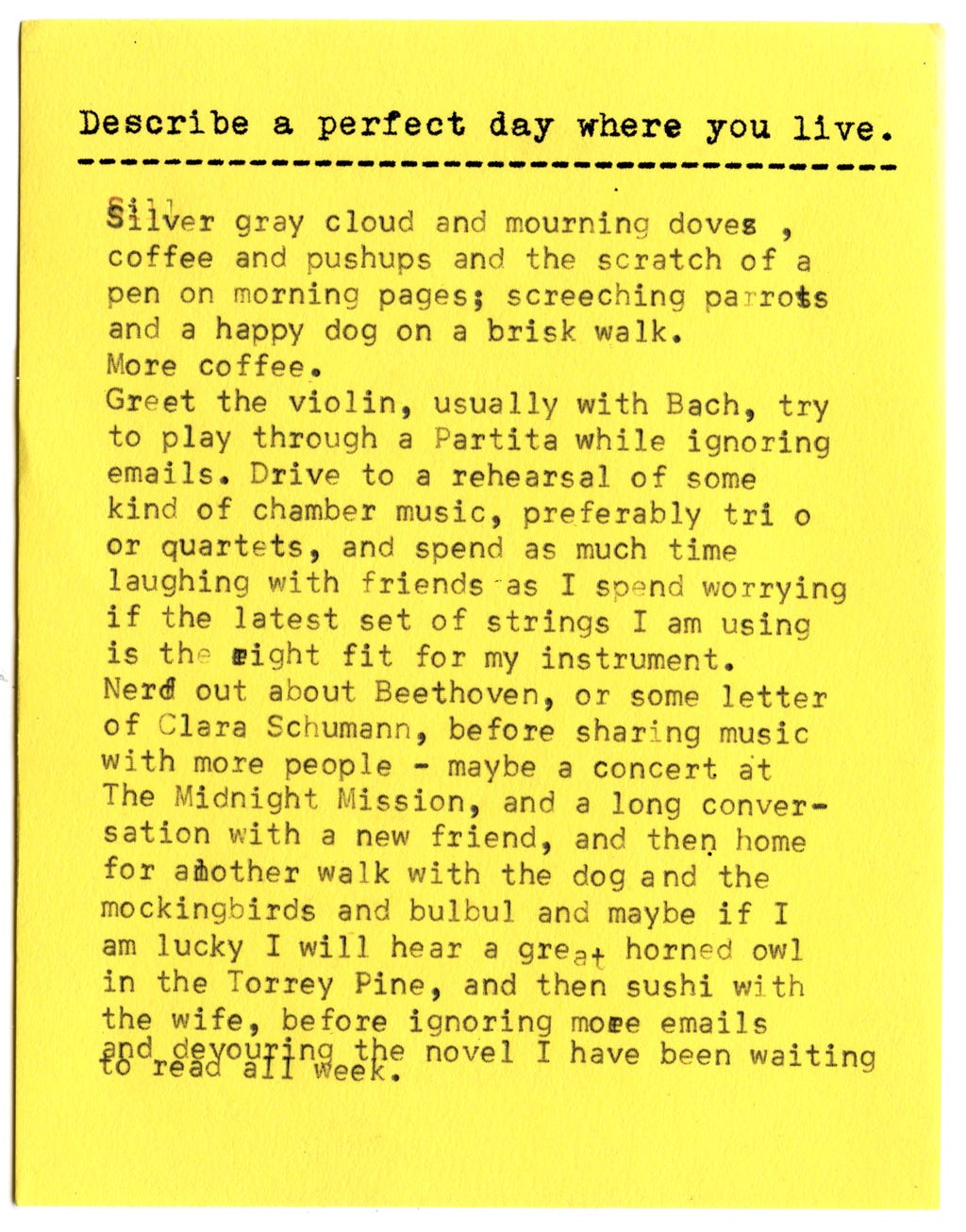
Describe a perfect day where you live.  Silver gray cloud and mourning doves, coffee and pushups and the scratch of a pen on morning pages; screeching parrots and a happy dog on a brisk walk.  More coffee.  Greet the violin, usually with Bach, try to play through a Partita while ignoring emails. Drive to a rehearsal of some kind of chamber music, preferably trio or quartets, and spend as much time laughing with friends as I spend worrying if the latest set of strings I am using is the right fit for my instrument.  Nerd out about Beethoven, or some letter of Clara Schumann, before sharing music with more people - maybe a concert at The Midnight Mission, and a long conversation with a new friend, and then home for another walk with the dog and the mockingbirds and bulbul and maybe if I am lucky I will hear a great horned owl in the Torrey Pine, and then sushi with the wife, before ignoring more emails and devouring the novel i have been waiting to read all week.
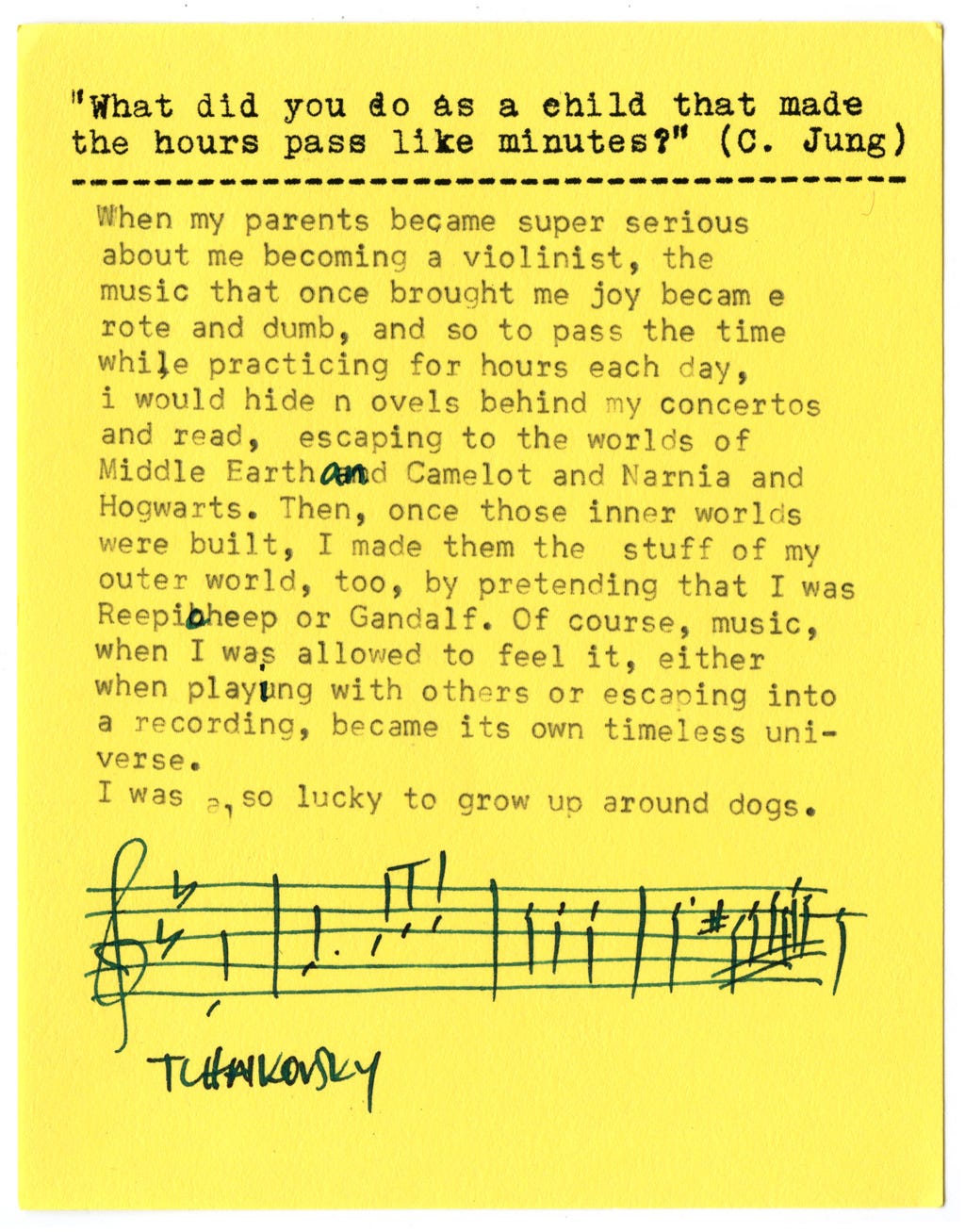
"What did you do as a child that made the hours pass like minutes?" (C. Jung)  When my parents became super serious about me becoming a violinist, the music that once brought me joy became rote and dumb, and so to pass the time while practicing for hours each day, I would hide novels behind my concertos and read, escaping to the worlds of Middle Earth and Camelot and Narnia and Hogwarts. Then, once those inner worlds were built, I made them the stuff of my outer world, too, by pretending that I was Reepicheep or Gandalf. Of course, music, when I was allowed to feel it, either when playing with others or escaping into a recording, became its own timeless universe.  I was also lucky to grow up around dogs.
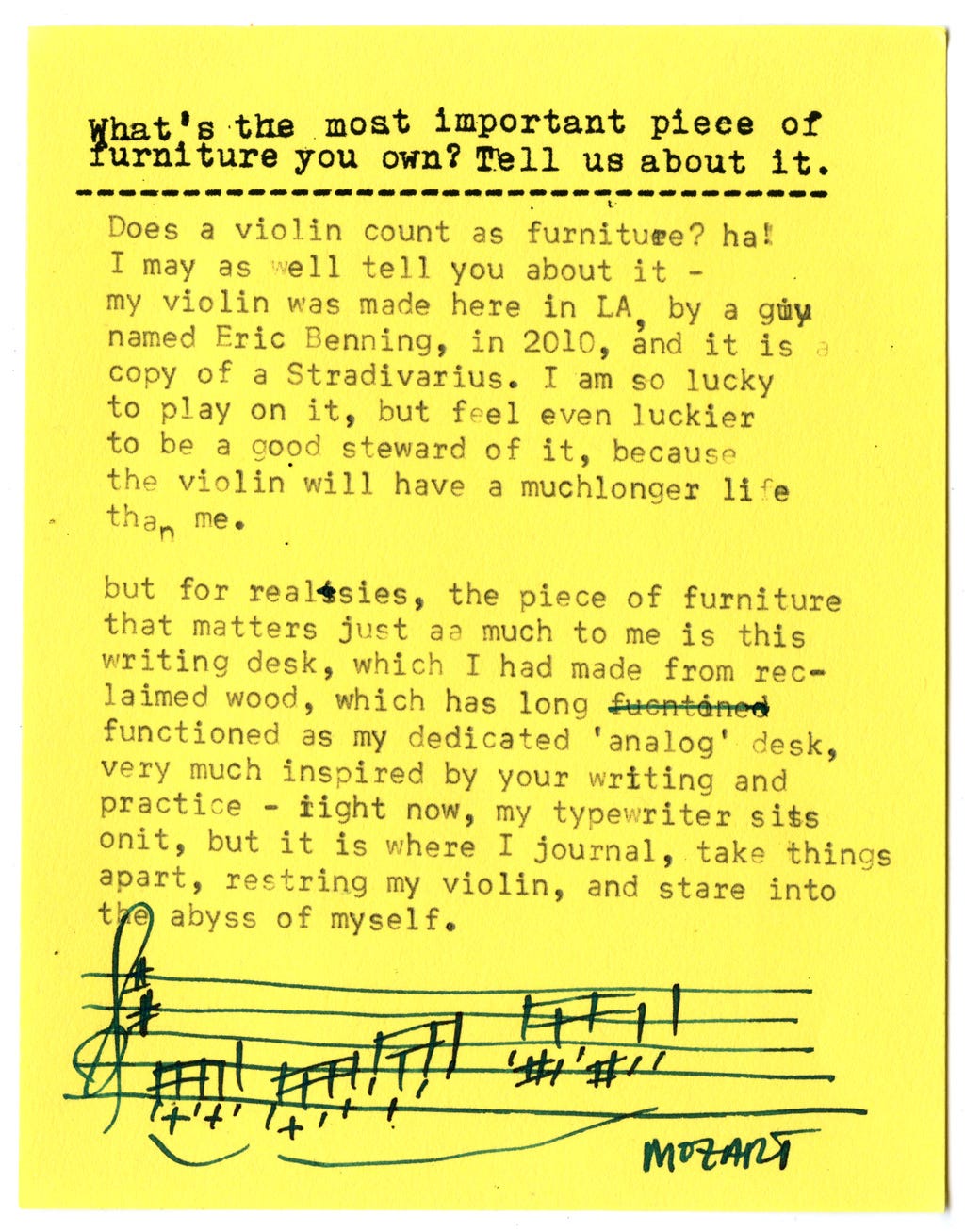
What's the most important piece of furniture you own? Tell us about it.  Does a violin count as furniture? Ha!  I may as well tell you about it - my violin was made here in LA, by a guy named Eric Banning, in 2010, and it is a copy of a Stradivarius. I am so lucky to play on it, but feel even luckier to be a good steward of it, because the violin will have a much longer life than me.  But for realsies, the piece of furniture that matters just as much to me is this writing desk, which I had made from reclaimed wood, which has long functioned as my dedicated 'analog' desk, very much inspired by your writing and practice - right now, my typewriter sits on it, but it is where I journal, take things apart, restring my violin, and stare into the abyss of myself.
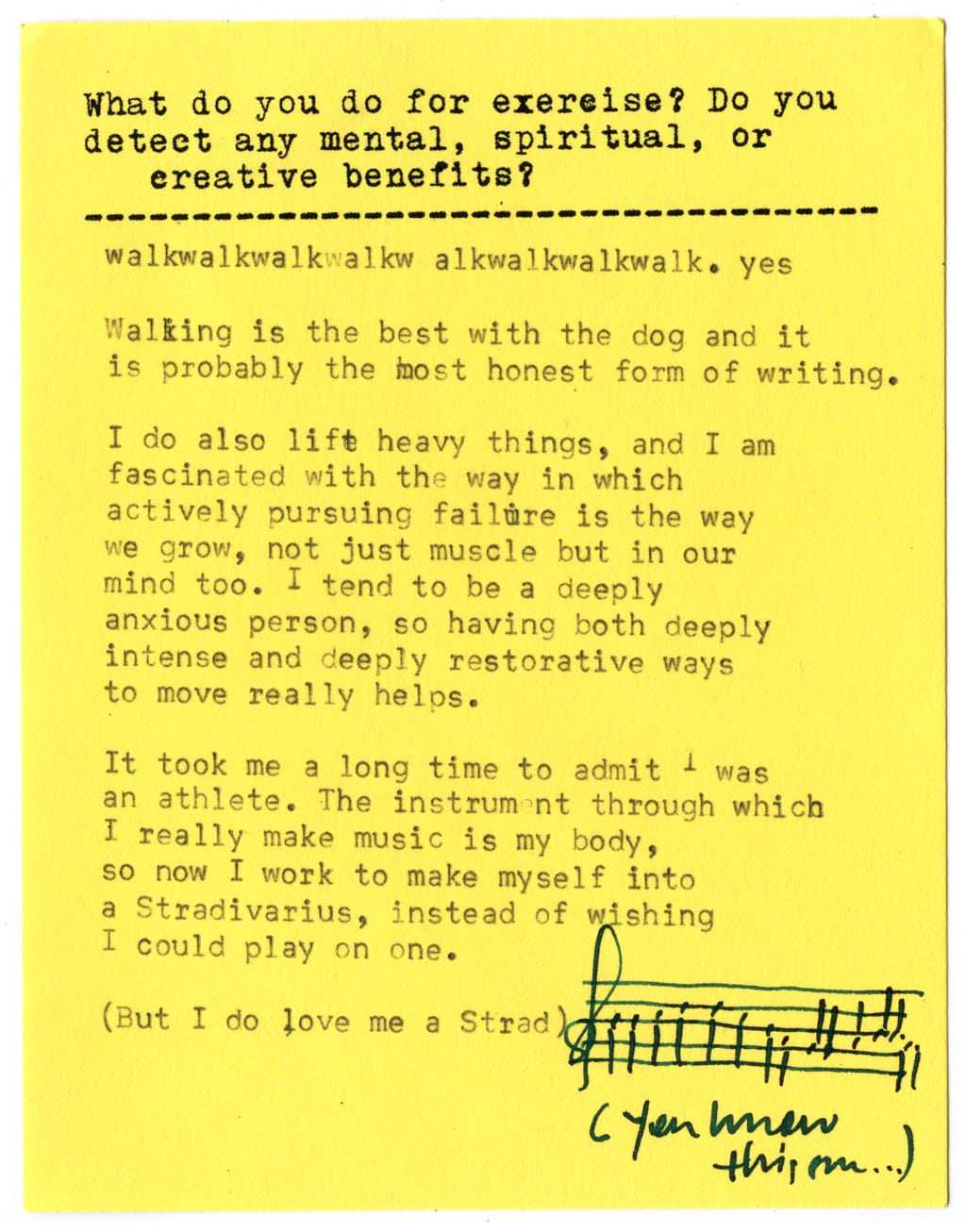
What do you do for exercise? Do you detect any mental, spiritual, or creative benefits?  walkwalkwalkwalkw alkwalkwalkwalk. yes  Walking is the best with the dog and it is probably the most honest form of writing.  I do also lift heavy things, and I am fascinated with the way in which actively pursuing failure is the way we grow, not just muscle but in our mind too. I tend to be a deeply anxious person, so having both deeply intense and deeply restorative ways to move really helps.  It took me a long time to admit I was an athlete. The instrument through which I really make music is my body, so now I work to make myself into a Stradivarius, instead of wishing I could play on one•  (But I do love me a Strad)

This typewriter interview is made possible by the kind support of paid subscribers.

Do you have any hobbies? Do you collect anything?  pens watches rocks books bows typewriters cameras caps from various cities I visit violin cases stocks of film, did I say books?  I am happiest while pursuing not just a hobby, but a hobby I can get better at: the most recent one is roasting coffee which requires constant motion because I roast on a stovetop popcorn popper, and it involves all the senses, and the margins of error are very thin, and the upsides are very tasty.  I love cooking for everyone but myself. knives records cable management systems dog toys diaries small precious things to put on display [tchotchkes] and I have a thing for wooden boxes, too, maybe because I am always finding a way to compartmentalize and organize all of my hobbies...  also fountain pen ink, the most recent obsessions are J. Herbin and Pilot Iroshizuku...
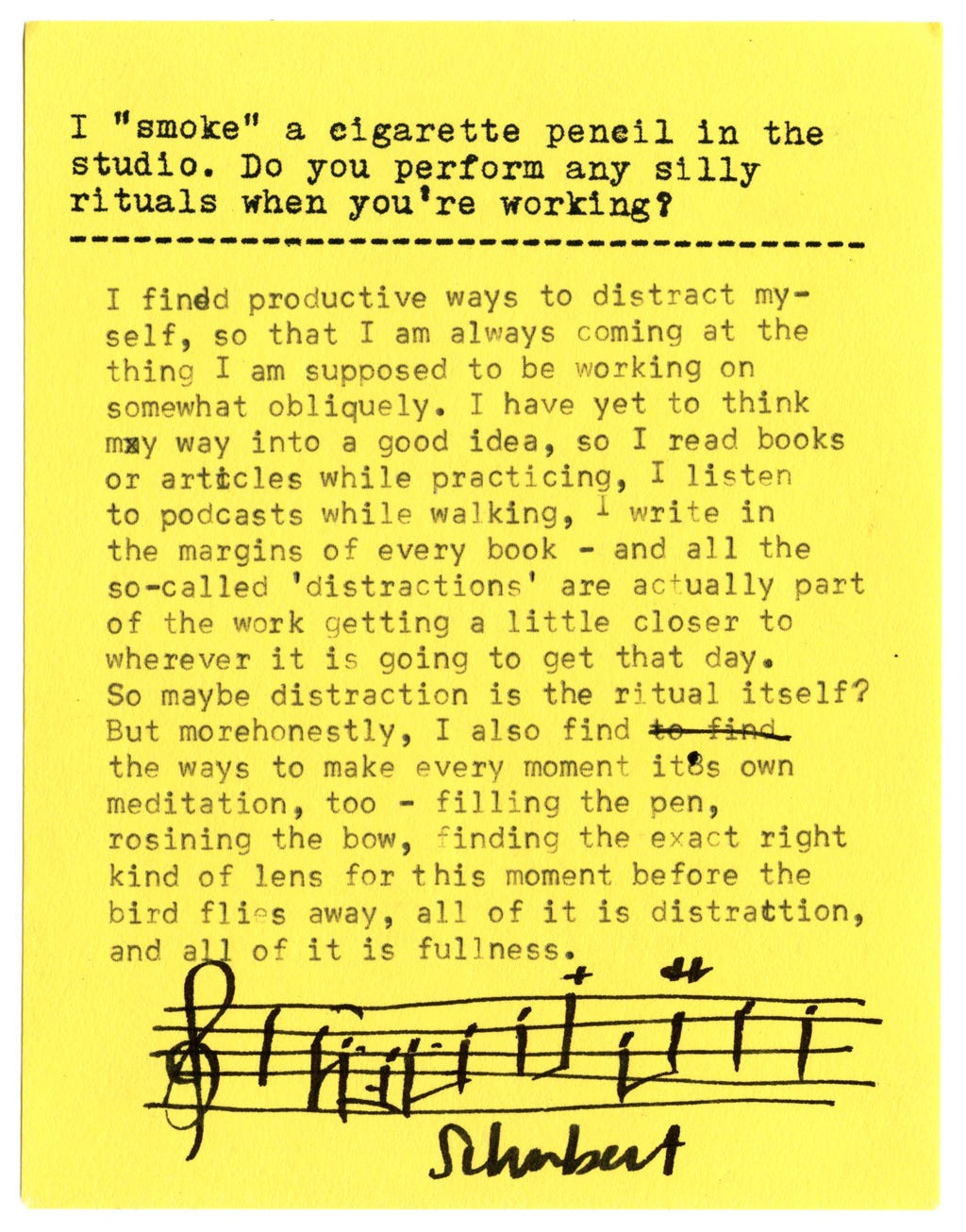
I "smoke" a cigarette pencil in the studio. Do you perform any silly rituals when you're working?  I find productive ways to distract myself, so that I am always coming at the thing I am supposed to be working on somewhat obliquely. I have yet to think may way into a good idea, so I read books or articles while practicing, I listen to podcasts while walking, I write in the margins of every book - and all the so-called 'distractions' are actually part of the work getting a little closer to wherever it is going to get that day.  So maybe distraction is the ritual itself?  But more honestly, I also find to find the ways to make every moment its own meditation, too - filling the pen, rosining the bow, finding the exact right kind of lens for this moment before the bird flies away, all of it is distraction, and all of it is fullness.
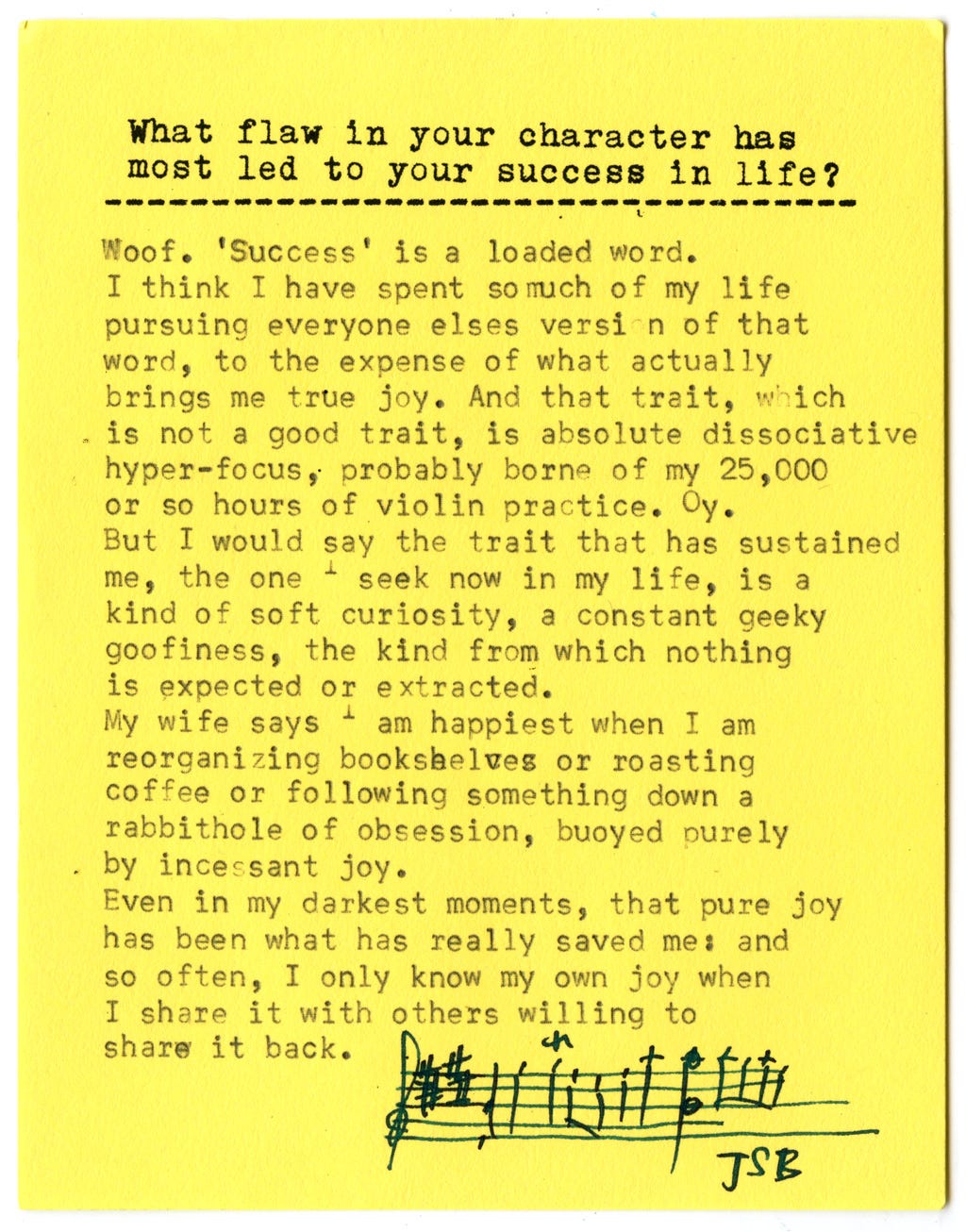
What flaw in your character has most led to your success in life?  Woof. 'Success' is a loaded word.  I think I have spent so much of my life pursuing everyone else's version of that word, to the expense of what actually brings me true joy. And that trait, which is not a good trait, is absolute dissociative hyper-focus, probably borne of my 25,000 or so hours of violin practice. Oy.  But I would say the trait that has sustained me, the one I seek now in my life, is a kind of soft curiosity, a constant geeky goofiness, the kind from which nothing is expected or extracted.  My wife says I am happiest when I am reorganizing bookshelves or roasting coffee or following something down a rabbithole of obsession, buoyed purely by incessant joy.  Even in my darkest moments, that pure joy has been what has really saved me: and so often, I only know my own joy when I share it with others willing to share it back.
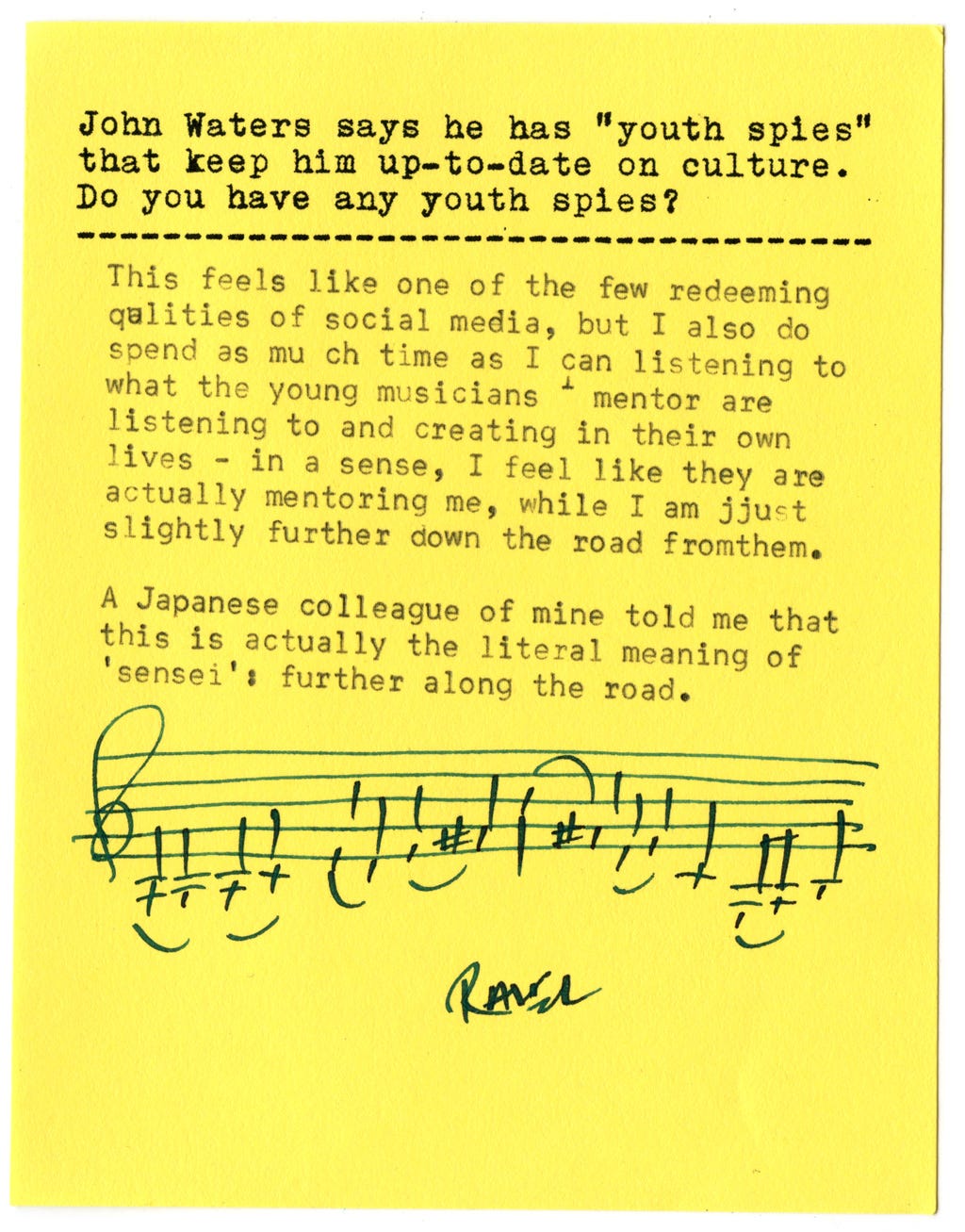
John Waters says he has "youth spies" that keep him up-to-date on culture. Do you have any youth spies?  This feels like one of the few redeeming qualities of social media, but I also do spend as much time as I can listening to what the young musicians I mentor are listening to and creating in their own lives - in a sense, I feel like they are actually mentoring me, while I am just slightly further down the road from them. A Japanese colleague of mine told me that this is actually the literal meaning of 'sensei': further along the road.
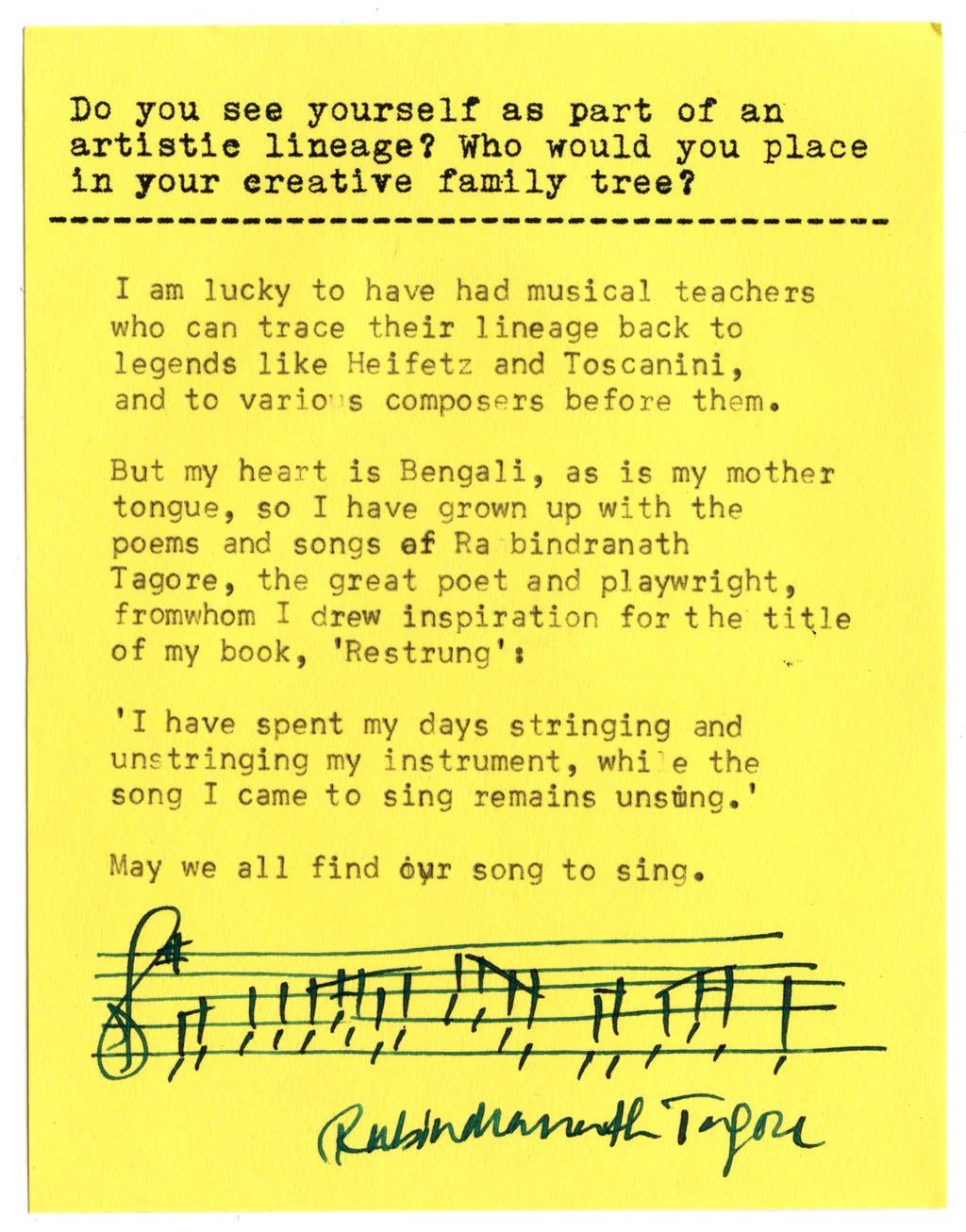
Do you see yourself as part of an artistic lineage? Who would you place in your creative family tree?  I am lucky to have had musical teachers who can trace their lineage back to legends like Heifetz and Toscanini, and to various composers before them.  But my heart is Bengali, as is my mother tongue, so I have grown up with the poems and songs af Rabindranath Tagore, the great poet and playwright, from whom I drew inspiration for the title of my book, 'Restrung':  'I have spent my days stringing and unstringing my instrument, while the song I came to sing remains unsung.'  May we all find our song to sing.

Huge thanks to Vijay for being the 22nd participant in this series of typewriter interviews. If you loved this interview, you’ll love his new memoir, Restrung: A Memoir of Music and Transformation.

And thanks, as always, to paid subscribers who buy me the time to do all the email coordinating, typing, snail-mailing, scanning, transcribing, and editing that goes into them.

xoxo,

Austin

P.S. Here is a plain-text version of our interview with links:

Keep reading with a 7-day free trial

Subscribe to Austin Kleon to keep reading this post and get 7 days of free access to the full post archives.

Already a paid subscriber? Sign in
© 2026 Austin Kleon · Privacy ∙ Terms ∙ Collection notice
Start your SubstackGet the app
Substack is the home for great culture