Quitting the chocolate factory
Today’s letter + an invitation to chat with art coach Beth Pickens
I’m Zooming with Beth Pickens (author of Make Your Art No Matter What) this Thursday, August 24 at 6PM central. A free registration link is at the bottom of this letter…
Hey y’all,
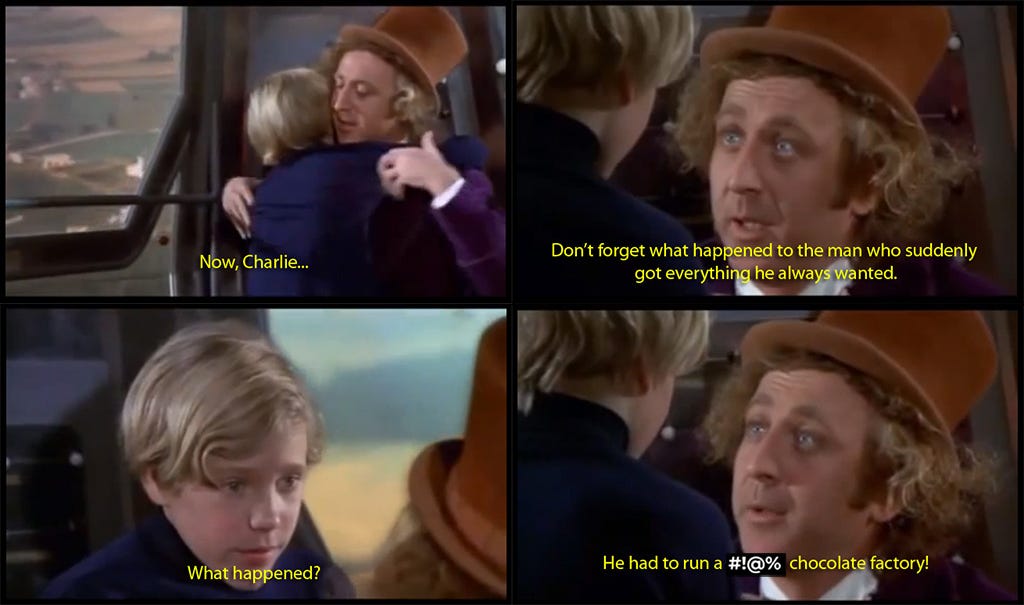
We watched Willy Wonka and the Chocolate Factory (1971) with the boys on Friday night. The boys liked it. I found myself worrying about Charlie Bucket. I pictured Charlie at 40 years old, the appointed heir, the blank slate, running the chocolate factory like Wonka instructed him to, doing work he never really chose for himself. Besides the supply chain issues and the Oompa Loompa labor strikes, one can imagine the lump growing in Charlie’s stomach, and the day he finally snaps.
We could borrow the scene of Sherwood Anderson in Mark Slouka’s essay, “Quitting The Paint Factory”:
…in the middle of dictating a letter to his secretary (”The goods about which you have inquired are the best of their kind made in the…”), he simply stopped. According to the story, the two supposedly stared at each other for a long time, after which [he] said: “I have been wading in a long river and my feet are wet,” and walked out. Outside the building he turned east toward Cleveland and kept going. Four days later he was recognized and taken to a hospital suffering from exhaustion.
What will Charlie do with his mid-life crisis? I wondered to myself. There’s your sequel!
(It suddenly occurs to me that it might be time to re-watch Hook, which is about Peter Pan’s mid-life crisis.)
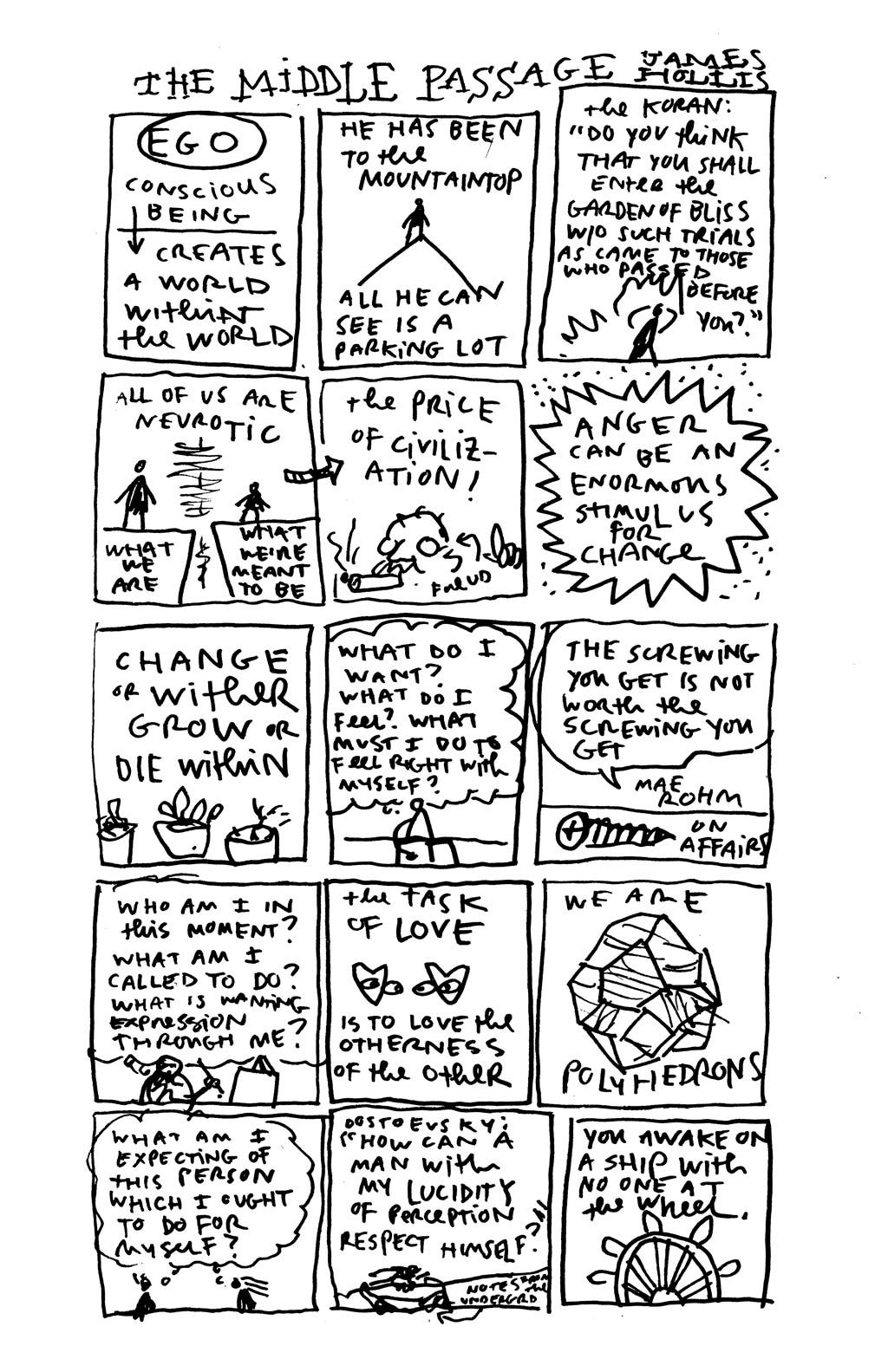
All of this is on my mind because I’ve been re-reading Carl Jung and the work of the Jungian analyst James Hollis. Over the weekend I finished Hollis’s 1993 book, The Middle Passage: From Misery to Meaning in Mid-Life. I knew I was going to like it the minute I saw the epigraphs:
Hollis recasts mid-life not as a crisis, but a passage. An opportunity to change that’s not to be wasted.
He doesn’t really have a lot of answers. What he has is really good questions.
One of them is: “Will this enlarge or diminish me?”
Another is: “What is wanting to find expression in the world through me?”
Yet another is: “From whence comes my real authority?”
In an interview from last year, Hollis explained that we’re born with a kind of personal authority and instinct, but he says that we “immediately have to trade it away because the demands of the environment are so large. We have to sort of constantly be trading off with our environment until we lose contact with it.” When we lose that spark that we have as kids, he says, eventually we have to recover it.
“Permission is to be seized,” Hollis writes. “Not requested.”
This reminded me so much of what Verlyn Klinkenborg says about writing as an act of perpetual self-authorization:
Who’s going to give you the authority to feel that what you notice is important?
It will have to be you….Being a writer is an act of perpetual self-authorization.
No matter who you are.
Only you can authorize yourself….
No one else can authorize you.
No one.
It’s important for the creative person to keep in mind that while rejection hurts, acclaim can be downright toxic to one’s process.
I was reading an old interview with the film director Sidney Lumet and he spoke of his relationship with film critics:
"I antagonize them… I think it's that I won't be put into the mold of their expectations. I have seen more good talent ruined by trying to live up to an idea of itself. That's why Pauline Kael and I are such enemies. She was wonderful to me in the beginning, but she had some idea of me I wasn't very interested in."
The real rift between Lumet and Kael came on "a very difficult evening" when the two of them got involved in one of those boring conversations about the function of a critic. "There were two other people present," Lumet recalls, "and she said to them, ’My job is to show him’ — pointing to me — ‘which direction to go in.’ I looked at her and said, ‘You've got to be kidding.’ She said, ‘No, I'm not.’ I said, ‘In other words, you want the creative experience without the creative risk.’ And that was it. She's never written a good word about me since.”
He went on to insist that in order to grow as an artist, he simply could not make work with his critics in mind:
“I consider my career — and this could be the most pretentious thing of all, I don't know — an ongoing process. I don't know how good I am. I know I'm good, but I don't know how good. And I'm not going to find out unless I keep pushing against the borders. The borders are my borders. They can't be Andrew Sarris’s borders, they can't be Pauline Kael’s borders. They can't belong to anyone but me.”
(Lumet wrote a wonderful book called Making Movies.)
One of the wildest things an artist can do is turn their backs to their own success. (Or suckcess.) Here’s Marjane Satrapi on why she doesn’t make comics anymore:
Keep reading with a 7-day free trial
Subscribe to Austin Kleon to keep reading this post and get 7 days of free access to the full post archives.


